
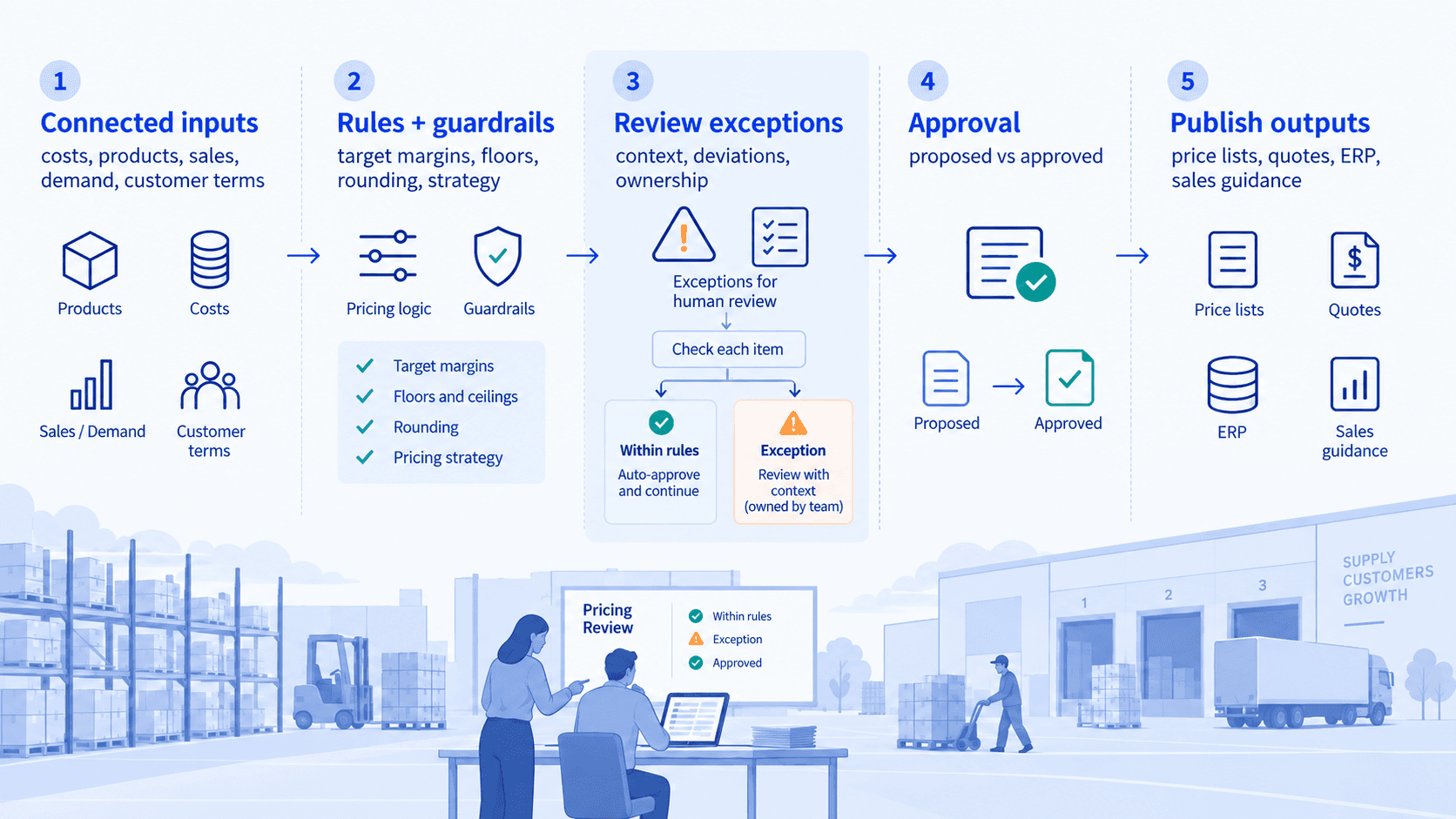
That is where b2b price list management software earns its place. For distributors and manufacturers with large catalogs, price-list work is not simply publishing a file. It is a controlled process that connects product data, costs, sales context, pricing rules, review decisions, and downstream execution.
Price Lists Are Commercial Decisions, Not Just Outputs
A published price list represents a set of decisions about revenue, margin, customer relationships, and market position. In a smaller business, those decisions may be held by a handful of experienced people. At catalog scale, relying on individual memory becomes risky.
The difficulty is rarely limited to calculating a list price. A pricing manager may need to account for multiple supplier costs, product families, customer segments, regional terms, contract commitments, strategic accounts, and price floors. Finance needs confidence that margin guardrails are respected. Sales needs to understand what changed and where discretion remains. Operations needs an accurate, usable output.
When these inputs are managed in disconnected places, a price list can become hard to defend. Two versions may circulate. An exception may be approved verbally but never recorded. A cost update may be reflected in one customer list but missed in another. The result is not merely administrative friction. It is margin leakage, delayed execution, and reduced confidence in the numbers.
Effective price list management creates a traceable path from the underlying data to the published result.
What B2B Price List Management Software Should Control
The right system should not treat price lists as static documents stored at the end of a process. It should support the work required to create, review, approve, and apply them.
Bring the Relevant Data Into One Working View
Price lists depend on more than an item master and a proposed sell price. Teams need current product attributes, supplier costs, sales history, demand signals, existing prices, and customer or channel context. They also need to know whether the incoming data is complete enough to support a decision.
A connected system makes those inputs visible in a structured working environment. This does not eliminate the need for data stewardship. It makes data quality issues easier to identify before they become pricing errors. Missing cost records, unmatched product identifiers, unusual sales patterns, and outdated classifications should be surfaced for review rather than buried inside a published file.
As catalogs grow, data intake and normalization become operational requirements. The question is not whether exceptions exist. The question is whether they can be identified, assigned, and resolved without stopping the entire pricing cycle.
Apply Rules Without Erasing Judgment
Rule-based pricing is valuable because it establishes consistency. A category may require a target margin, a minimum dollar contribution, a defined pass-through treatment, or a specific rounding convention. These rules give teams a practical starting point across a broad catalog.
However, a rule is not a substitute for commercial judgment. A high-volume product with competitive sensitivity may require different treatment from a low-volume specialty item. A strategic customer may have terms that should not be overwritten by a general update. A temporary inventory position may warrant a controlled deviation.
B2B price list management software should make this distinction clear. It should allow teams to apply repeatable logic at scale, then isolate the items or accounts that require human review. The goal is not to automate every decision. It is to direct attention to the decisions that matter most.
Make Exceptions Visible and Accountable
Exceptions are common in B2B pricing. They are not necessarily a sign of poor discipline. The problem arises when exceptions are invisible, inconsistent, or unowned.
A governed process should make clear why an item or customer received different treatment, who is responsible for the decision, and whether the exception has an effective date or review point. That record matters when a sales representative asks why a price changed, when finance reviews margin movement, or when leadership wants to understand the commercial impact of a policy.
The best approach depends on the business. Some organizations need tight central approval for nearly all deviations. Others need category managers or regional leaders to act within defined guardrails. In either case, responsibility should be explicit. The process should preserve enough context to understand how the final price was reached without forcing every pricing decision through the same path.
A Better Operating Model for Price List Changes
Price-list management becomes more reliable when teams separate the process into clear stages. The stages do not need to be bureaucratic. They need to answer the right questions in the right order.
First, establish the decision set. Identify the products, customers, channels, and effective dates in scope. Confirm which data sources and cost assumptions will be used. This prevents an update from expanding informally as new requests appear.
Next, generate proposed pricing using the applicable strategy, rules, and margin guardrails. At this point, the objective is coverage and consistency. Teams should be able to see where rules produce expected results and where they create material changes, low margins, or unusual patterns.
Then move into review. A dedicated pricing workbench is more useful than a static extract because it allows reviewers to evaluate proposed changes in context. They can filter by category, account, margin effect, sales volume, or change magnitude. This focuses discussion on the items that deserve attention instead of forcing teams to inspect every row equally.
Approval should follow review according to the organization's authority structure, with a clear distinction between a proposed price and one that is ready for execution. That distinction matters. Review is where teams investigate and challenge a proposal. Approval is where accountable people authorize the result for use.
Finally, publish controlled outputs for the systems and users that need them. Depending on the operating model, that may include customer price lists, sales guidance, quote inputs, ERP exports, or internal reports. The publishing step should preserve the reviewed pricing state rather than require someone to recreate it manually.
Where Isolated Tools Fall Short
Many organizations already have elements of this capability. They may use reporting tools for analysis, a configure-price-quote system for quoting, an ERP for price records, and shared files for category planning. Each tool can serve a legitimate purpose.
The gap appears between them. Analytics can highlight an opportunity but may not manage the resulting approval. A quote tool can produce a customer-specific price but may not show whether it conflicts with the current pricing strategy. An ERP can store an approved price but is often not the right environment for comparing scenarios and resolving exceptions.
A purpose-built pricing workflow can connect these stages without pretending that every decision can be reduced to a formula. NewAxiom, for example, brings data intake, pricing review, strategy, price lists, quotes, and exports into a connected environment. That structure keeps pricing work close to the product, cost, sales, and demand information that informs it while providing a clearer path from analysis to execution.
How to Evaluate B2B Price List Management Software
The evaluation should begin with the real operating workload, not a generic feature checklist. Ask how the system handles the price list your team finds difficult to manage today: the one with multiple cost sources, account-specific terms, category exceptions, and several approvers.
Look for evidence that the software can work with your existing data realities. Product catalogs are rarely perfectly clean, and source systems rarely share a single identifier or update schedule. The software should provide a disciplined way to bring data together, identify gaps, and maintain a usable decision set.
Also examine control points. Can users compare proposed and current prices? Can they see the margin implications of changes? Can exceptions be made visible for the appropriate review? Can the business distinguish working pricing from pricing that is ready to use? Can downstream outputs be produced without rekeying or uncontrolled edits?
Usability matters as much as capability. Pricing teams need enough detail to make defensible decisions, while sales and leadership need concise views of what changed and why. A system that only produces complex analysis may slow execution. A system that only publishes prices may leave too much judgment outside the process.
Start With One High-Value Pricing Cycle
A broad platform rollout is not always the right first move. Many organizations get better results by starting with a recurring price-list process that already creates friction, such as a category update, a customer segment review, or a scheduled cost-to-price adjustment.
Define the data required, the rules that apply, the people involved in review, and the expected output. Measure cycle time, unresolved exceptions, review turnaround, and margin exposure before and after the new process. Those measures reveal whether the operating model is improving, not just whether a new tool has been configured.
A dependable price list is one that can be explained, reviewed, and executed with confidence. Build the process around that standard, and the software becomes a practical control point for better commercial decisions.