
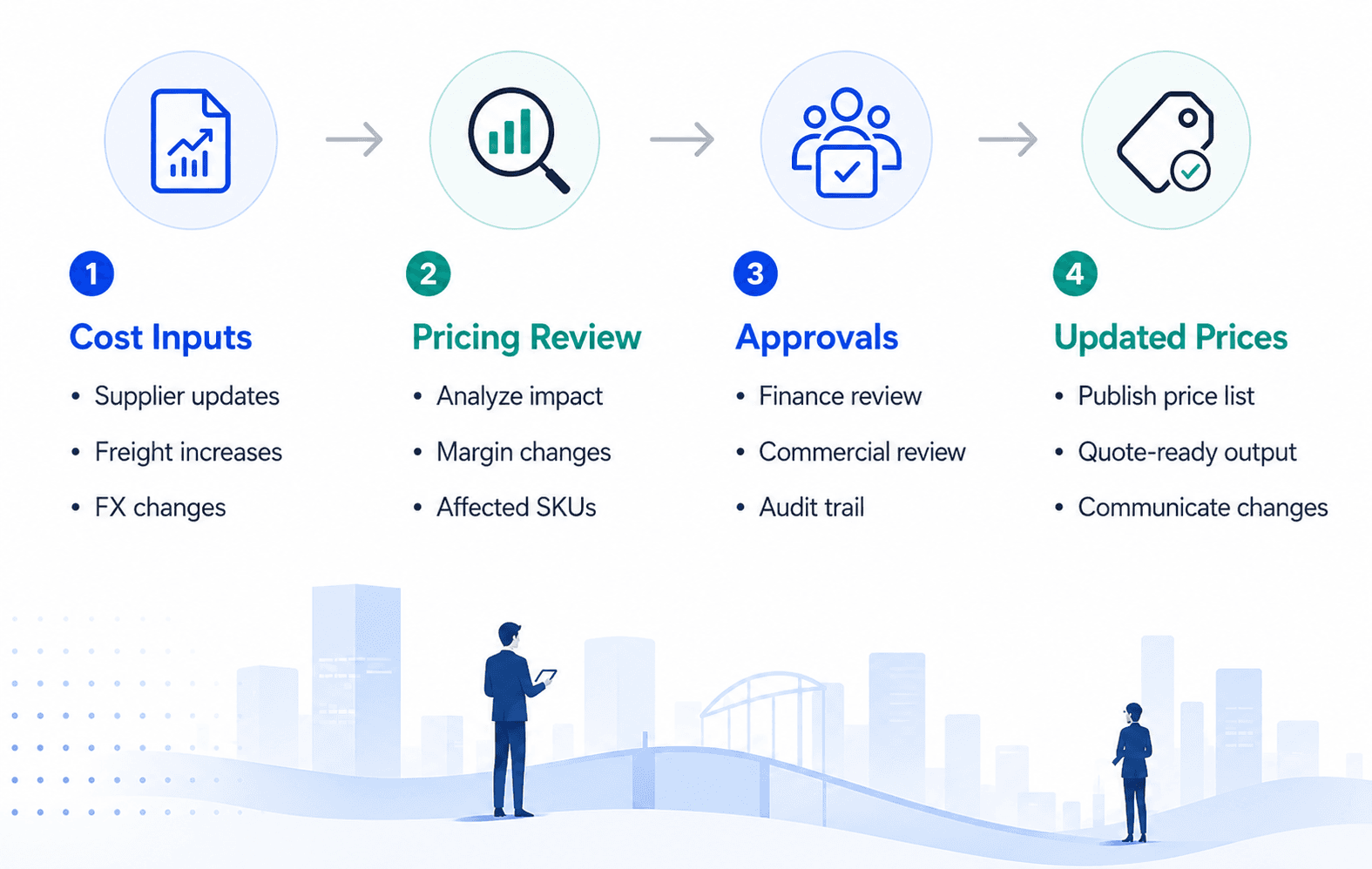
This is where B2B pricing workflow software earns its place. The challenge is not simply calculating a new price. It is moving from changing inputs to a reviewed commercial decision without losing control of the catalog, the rationale, or the exceptions.
For distributors, manufacturers, and wholesalers, pricing is a recurring operating process. It touches product master data, supplier costs, demand, customer agreements, category strategy, sales judgment, review checkpoints, quotes, and execution. When those activities live across spreadsheets, inboxes, reports, and isolated tools, the organization can produce prices quickly but still struggle to make consistent decisions.
Pricing Is a Workflow, Not a Calculation
A pricing formula can be useful, but it does not run a pricing operation. Commercial teams still need to decide which products are affected, whether a cost change is valid, which customers need different treatment, how market conditions alter the response, and which changes need deeper review before they become operating prices.
This distinction matters most in large catalogs. A modest supplier increase may affect thousands of SKUs, multiple branches, customer-specific price agreements, and different product categories. Applying one blanket markup may be fast, but it can create unnecessary volume risk in competitive categories or leave margin exposed where demand is less sensitive.
A controlled workflow creates a path from intake to execution. It gives teams a shared view of the inputs, proposed actions, comments, review status, and released outputs. The goal is not to remove human judgment. It is to make judgment repeatable, accountable, and usable at catalog scale.
What B2B Pricing Workflow Software Should Connect
The strongest operating model connects decisions that are often separated. Cost analytics, price review, demand context, quoting, and reporting should not behave like unrelated tasks. They should support the same commercial workflow.
Start with trusted pricing inputs
Every pricing decision depends on the quality and timing of its inputs. Product attributes, supplier cost files, current sales prices, historical volume, customer data, inventory signals, and demand measures often arrive from different sources and on different schedules. If the inputs cannot be aligned, the pricing team spends its time reconciling data instead of reviewing commercial impact.
A structured intake process should bring source data into a consistent model while preserving enough detail for teams to investigate exceptions. A pricing manager may need the supplier, effective date, product family, previous margin, sales history, and current customer commitments before recommending action.
This does not require every source system to be replaced. In many organizations, the ERP remains the system of record and the CRM remains central to account activity. A pricing workflow should coordinate review between systems, then provide controlled exports or handoff-ready outputs for execution.
Turn data into a reviewable workbench
A spreadsheet can hold a proposed price change, but it rarely shows the full decision context or protects the review from being overwritten. A dedicated Pricing Workbench helps teams filter affected products, compare current and proposed results, apply repeatable logic, and isolate items requiring review.
The workbench is where teams move from broad analysis to practical action. A category manager may review a group with falling margins. Sales operations may identify accounts exposed to a change. Finance may test whether a proposed floor protects required contribution. Rather than passing separate files between departments, each function can review the same pricing scenario with clearer context.
Demand also belongs in the discussion. A Demand Workbench can help teams distinguish between products where a price move may be absorbed and products where it could affect volume, customer retention, or competitive position. Demand signals are inputs to judgment, not automatic instructions.
Apply strategy without hiding exceptions
Pricing rules create consistency, particularly when a team must manage thousands of products. A structured workflow should support category-level logic, target margins, cost-pass-through approaches, rounding conventions, and planned review actions where those policies are defined.
Consistency is not the same as rigidity. A national account may have a contract price. A strategic product may need a lower margin to protect a larger basket. A supplier disruption may justify a temporary action rather than a permanent list-price move. Good workflow software makes these exceptions visible and deliberate instead of burying them in a local spreadsheet.
Review Controls Should Support Speed
Review is often viewed as a delay because the process is poorly designed. When a manager receives an email with a large attachment and no clear explanation of impact, the review becomes slow and cautious. When the reviewer can see the change, margin effect, relevant history, exception reason, and requested action in one place, review becomes a control point that supports speed.
A structured pricing workflow should reflect the organization's authority model. A routine adjustment within category expectations may need a light review. A change that drops below a margin floor, affects a named account, or departs from a supplier-cost policy may need broader commercial input. The workflow should make the reason for the extra review clear before the decision reaches operating use.
This history is useful beyond compliance. When a category underperforms after an increase, the team can look back at the original assumptions, exception decisions, and review rationale. That creates a better operating discipline than asking which version of a spreadsheet was used.
Execute Through Governed Price Lists and Quotes
A pricing decision has no commercial value until it reaches the people and systems that use it. Price Lists help turn reviewed outcomes into controlled pricing outputs for regions, segments, accounts, or other commercial contexts.
This prevents a familiar failure point: a pricing team reviews a change, but sales continues to quote from an outdated file or a branch applies the wrong list. For customer-specific business, quote-facing workflows need the same discipline. A quote should start from the right pricing context, show the commercial reason for any deviation, and preserve margin visibility before release.
For some organizations, the priority is rapid response to frequent supplier changes. For others, it is reducing inconsistency across branches or improving governance for negotiated accounts. The workflow design should reflect that reality. More controls can protect margin, but excessive review layers can slow customer response.
How to Evaluate a Pricing Workflow Platform
The evaluation should begin with the work your team must complete repeatedly, not with a feature checklist. Map a recent cost change, price review, or major quote from start to finish. Identify where data was manually assembled, where decisions waited, where exceptions were hidden, and where execution broke down.
Then assess whether the platform can support your catalog structure, current data sources, pricing rules, margin expectations, and review process. A system that produces sophisticated recommendations but cannot support the organization's review and release process will create another disconnected point tool.
NewAxiom supports this operating model with structured workspaces for pricing review, demand context, controlled price lists, and quote-facing workflows. The practical starting point is usually narrower than the full future-state process: supplier cost pass-through for a priority category, a recurring list-price review, or a clearer process for customer-specific quote context.
The best pricing process is one your team can run under pressure. When costs change, a customer calls, or leadership asks where margin is at risk, the answer should not depend on finding the right spreadsheet owner. It should come from a connected workflow that makes the next commercial decision clear.