
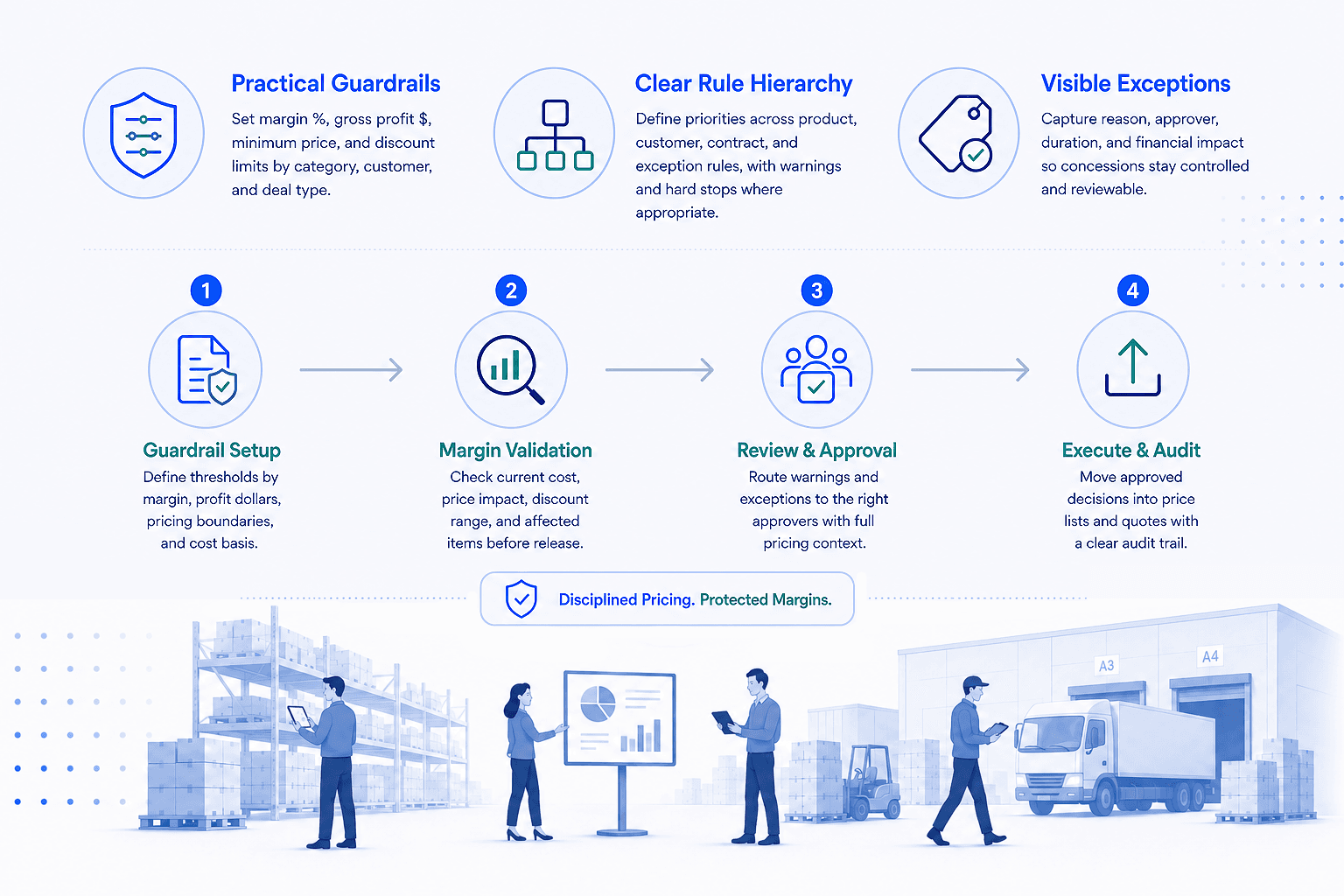
Without defined margin guardrails for wholesale pricing, the decision often comes down to individual judgment, incomplete cost visibility, and an approval process that starts after the margin has already been conceded.
Guardrails do not eliminate commercial discretion. For distributors and manufacturers managing thousands of SKUs, customers, and negotiated price relationships, they turn margin protection into a repeatable operating practice.
What Margin Guardrails Should Control
A margin guardrail is a business rule that sets an acceptable pricing boundary. It can be expressed as gross margin percentage, gross profit dollars, markup, a minimum net price, or a combination of these measures. The right measure depends on the category, customer, transaction size, and reliability of the underlying cost data.
A single company-wide minimum margin is rarely sufficient. A low-margin commodity line and a specialized replacement part should not necessarily be held to the same threshold. Nor should a one-time project quote be governed exactly like a recurring contract price. The objective is not uniformity for its own sake. It is consistent decision-making within commercial conditions that have been intentionally defined.
Effective guardrails usually control four related outcomes:
- Whether a proposed list price or quoted net price is acceptable without review.
- Whether the price produces enough gross profit dollars to justify the transaction.
- Whether a discount exceeds the expected range for a product group, customer segment, or deal type.
- Whether the proposal relies on an outdated, missing, or estimated cost.
The fourth control is frequently missed. A calculated margin is only as dependable as the landed cost behind it. When freight, duties, rebates, conversion costs, or supplier allowances are excluded or stale, a price can pass a margin test on paper while underperforming in the actual sale.
Build Margin Guardrails Around Real Decisions
Start with the decisions your team makes most often, rather than with an idealized pricing policy. Common decisions include updating a price list, responding to a customer-specific request, setting a contract price, quoting a project, and approving an exception at the order level. Each decision has a different risk profile and a different need for speed.
For catalog pricing, guardrails should support broad, controlled changes across product families. A pricing manager may decide that a category needs a target margin range, a minimum floor, and a tolerance for selected items where market pricing is especially visible. The rule should flag the exceptions that need attention, not force reviewers to inspect every SKU manually.
For quotes, the controls may need to be more contextual. A quote with a modest margin percentage may still be acceptable if it produces meaningful gross profit dollars, supports a larger package opportunity, or is tied to a defined customer agreement. Conversely, a high percentage margin on a very small order may not justify extended approval effort. Guardrails should surface the decision, along with the relevant facts, rather than treating every exception as identical.
Use a hierarchy, not a pile of rules
Pricing teams often accumulate rules over time: a product floor, a customer discount limit, a category minimum, a regional exception, and an account agreement. If the priority between those rules is unclear, users receive conflicting instructions and approval owners lose confidence in the result.
Define a simple hierarchy. For example, a contractual customer price may take precedence over a standard segment rule, while a product-level floor still prevents a transaction from falling below a defined minimum. Where an approved strategic exception is allowed, record its owner, effective dates, and reason. This makes the exception usable without silently turning it into a permanent default.
The hierarchy should also distinguish between a warning and a hard stop. A warning is appropriate when a reviewer may reasonably approve the price with context. A hard stop is appropriate when the proposed price violates a non-negotiable condition, such as a stated minimum net price or an expired agreement. Making too many rules hard stops encourages workarounds. Making every rule a warning creates noise and weakens accountability.
Choose Metrics That Reflect Profitability
Gross margin percentage is familiar and useful, but it should not carry the full burden of control. Consider a $20 item sold at a 40 percent margin and a $20,000 order sold at a 12 percent margin. The percentage alone does not explain the financial value, exposure, or strategic significance of each decision.
For that reason, many wholesale organizations pair a margin percentage floor with a gross profit dollar threshold. The percentage protects against structurally weak pricing, while gross profit dollars ensure that material concessions receive appropriate review. Product categories with volatile costs may also need a maximum allowable lag between cost effective date and price effective date.
Use markup carefully. It is useful in some category and supplier discussions, but it is not interchangeable with margin. A 25 percent markup produces a 20 percent margin, while a 25 percent margin requires a 33.3 percent markup. If finance, pricing, and sales use different measures without a shared definition, approval conversations become slower and less precise.
The cost basis needs equal discipline. Decide which cost is used for each guardrail: standard cost, latest purchase cost, landed cost, weighted average cost, or a negotiated customer-specific cost. There is no universal answer. What matters is that the selected basis is visible and appropriate to the decision being made.
Make Exceptions Visible, Time-Bound, and Reviewable
A guardrail that cannot accommodate justified exceptions will be bypassed. A guardrail that accepts undocumented exceptions will eventually become irrelevant. The practical middle ground is an exception process that captures the reason, financial impact, approver, and duration.
Reasons should be specific enough to analyze later. Competitive match, inventory disposition, contract commitment, bundle economics, and strategic account retention are more useful than a generic business need. Over time, recurring exception reasons may reveal a deeper issue: an uncompetitive list price, an inaccurate cost, an outdated segment rule, or a product category that needs a different strategy.
Duration matters because temporary approvals tend to become embedded in price history. Set effective dates for customer-specific concessions and review them before renewal. A price that was sensible during a short-term market disruption may be damaging six months later, especially if costs or demand have changed.
Approval routing should match exposure. A small, low-risk concession may sit within sales leadership authority. A quote that falls below a category floor, has a large revenue value, or affects a key account may require pricing, finance, or commercial leadership review. The point is not to create layers of administration. It is to place the right decision with the person who can evaluate its trade-offs.
Connect the Rules to Data, Review, and Execution
Guardrails only work when the underlying data and operating process are connected. Product attributes determine which rules apply. Cost records determine the margin calculation. Customer and sales history provide context. Price lists and quotes are where approved decisions must be executed accurately.
In NewAxiom, teams can bring these inputs together through connected data workflows, then evaluate proposed changes in the Pricing Workbench and quote decisions with the relevant pricing context. This supports a governed process where rules can identify items for review, approvers can assess exceptions, and approved prices can move into price lists or quote outputs with a clear record of the decision.
The value is not merely faster calculation. It is the ability to answer practical operating questions: Which items failed the floor? Which customer agreements are nearing expiration? Which category generates the most margin exceptions? Which approved concessions are now outside the intended policy? Those answers allow teams to improve the rule set rather than repeatedly managing the same symptoms.
Test Guardrails Before Making Them Mandatory
A new policy should be tested against historical sales and quotes before it is enforced. Run recent transactions through the proposed thresholds and inspect the result. If half of normal business is flagged, the rule may be too broad, the category segmentation may be weak, or the cost basis may not reflect reality. If almost nothing is flagged, the policy may not be protecting the areas that matter.
Review false positives with the people closest to the work. Sales can identify legitimate market realities. Category managers can explain product economics. Finance can assess the cumulative impact. Pricing leaders can decide whether the answer is a revised threshold, a targeted exception, or a separate rule for a distinct business case.
Guardrails should be reviewed on a defined cadence, particularly after major cost changes, category strategy shifts, or changes in customer agreements. The goal is not constant adjustment. Stable rules build trust. But stability should come from deliberate review, not from leaving old assumptions in place.
A well-designed guardrail gives teams room to act while making the cost of an exception visible. That is the standard worth aiming for: routine decisions move with confidence, high-risk decisions receive attention, and every approved price can be explained after the fact.