
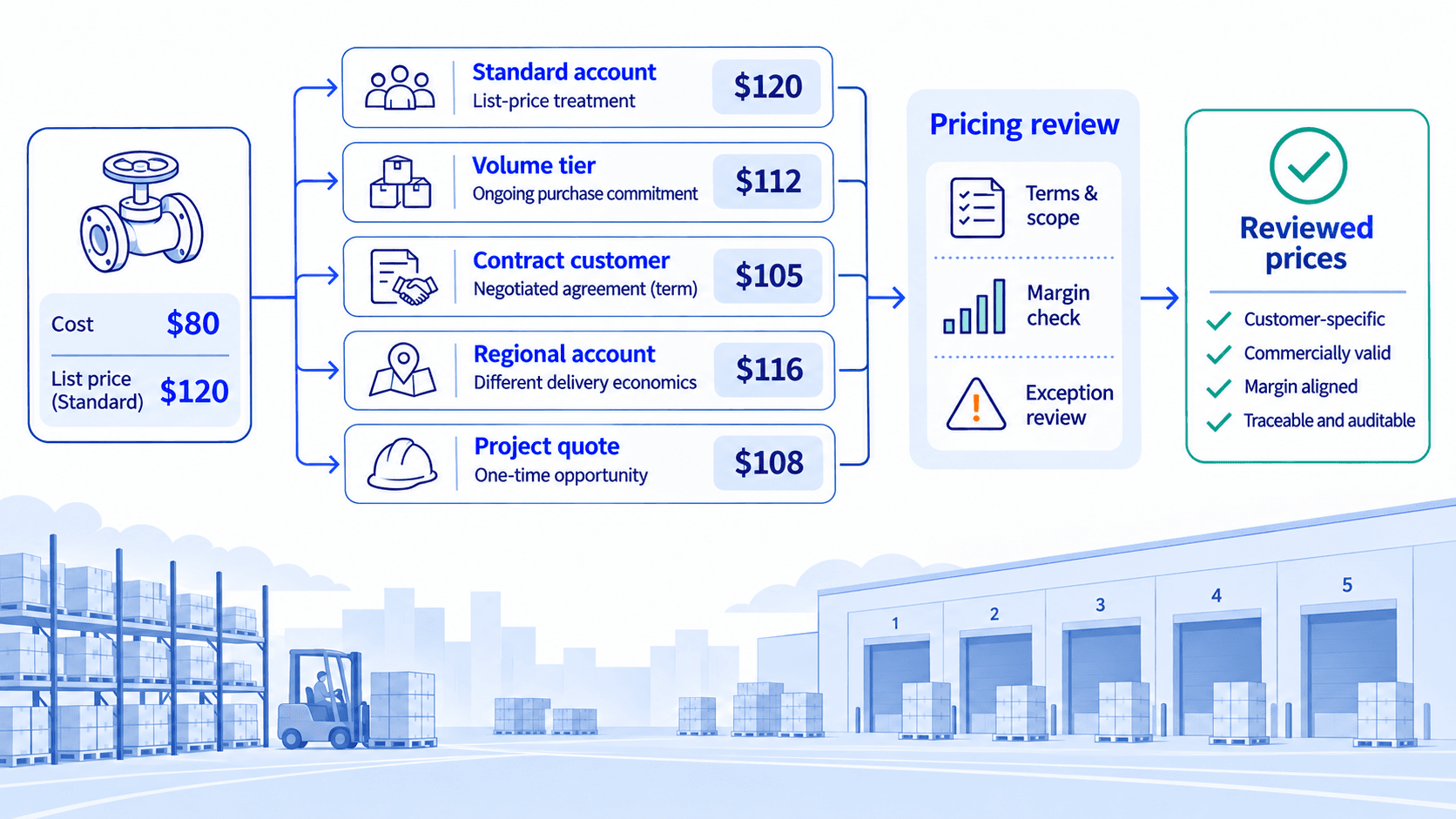
A customer price is rarely just a price. The same product might sell at one price to a standard account, another to a high-volume buyer, and a third under a negotiated contract. Add regional freight costs, project quotes, changing supplier costs, and category-level margin expectations, and the differences can be entirely legitimate.
The difficulty begins when nobody can easily explain those differences or tell which price should apply to the next order. For distributors and manufacturers with broad catalogs, customer-specific pricing management software should make the underlying conditions easier to understand, review, and maintain, rather than simply calculate another number.
Why one product can have several valid prices
Consider an industrial distributor selling a component with a standard list price of $120 and a current cost of $80. The distributor may have several commercial relationships to account for:
| Customer situation | Illustrative selling price | Commercial consideration |
|---|---|---|
| Standard account | $120 | Standard list-price treatment |
| Volume-tier customer | $112 | Ongoing purchasing commitment |
| Contract customer | $105 | Negotiated agreement and term |
| Regional account | $116 | Different delivery or freight economics |
| Project buyer | $108 | One-time competitive opportunity |
Illustrative example only; prices are not NewAxiom recommendations.
Each price produces a different gross margin against the same $80 cost. At $120, the gross margin is 33.3%; at $105, it is approximately 23.8%. Neither price is automatically right or wrong. The relevant questions are whether the commercial terms justify it, whether it meets the business's margin expectations, and whether the team knows when that price is applicable.
Now multiply those variations across thousands of SKUs and many accounts. The challenge is no longer maintaining a single price list. It is maintaining the relationships between products, customers, rules, exceptions, and dates without letting them drift apart.
Separate standard pricing from customer commitments
A practical pricing structure starts by distinguishing the normal pricing position from deliberate deviations. Standard list prices, category rules, and customer tiers provide consistency. Contract commitments, project-specific quotes, and negotiated exceptions provide flexibility where the commercial relationship warrants it.
Those layers should not be treated as interchangeable. A volume-tier price may apply across a defined product group. A contract price may apply only to specified SKUs for a stated term. A project quote may be valid for one opportunity but should not quietly become the customer's permanent buying price.
When the conditions are unclear, sales teams may use an outdated agreement, apply a discount too broadly, or rely on a price copied from a previous quote. A sound management process makes the scope and rationale explicit: which customer, which products, which pricing basis, and which conditions determine the result.
This is also why price precedence matters. Businesses should define how a contract price, customer-specific override, category rule, and standard list price interact when more than one could apply. The rule should be documented and tested against actual customer scenarios, not left to individual interpretation.
Connect the information behind the price
Customer-specific decisions are difficult to review when product masters, costs, sales history, agreements, and current prices sit in separate files. Each source may be accurate on its own while the combined pricing picture is incomplete.
Before revising a customer price, a team should be able to establish the relevant product and customer identifiers, cost basis, current selling price, recent sales activity, applicable pricing terms, and any known exception. Demand trends and category strategy can provide additional context, but they should inform judgment rather than be treated as a guarantee of how a customer will respond.
Data connectors and standardized imports can reduce repeated data preparation. They do not remove the need to validate source records. Missing costs, mismatched SKUs, stale dates, and inconsistent customer identifiers should be resolved or explicitly set aside before pricing decisions are finalized.
The point is not to replace every source system. It is to bring enough reliable information together that the people responsible for pricing can make a defensible decision.
Apply pricing rules without erasing commercial exceptions
Rules help teams apply consistent markups, margins, category treatments, and customer pricing policies. They also reduce the need to revisit routine calculations one item at a time.
But a rule cannot anticipate every commercial circumstance. A strategic account may have a volume commitment. A regional market may face different competitive conditions. A project quote may justify a temporary concession. These are reasons to review the standard result—not reasons to abandon pricing discipline.
A useful approach is to distinguish three outcomes:
- Routine: The proposed price fits the relevant pricing rule and margin expectations.
- Review needed: The proposed price crosses a threshold, conflicts with an agreement, or involves incomplete data.
- Intentional exception: A different commercial outcome is justified, with its scope, rationale, and responsible decision-maker understood.
Margin guardrails help identify where attention is needed. A low margin may be acceptable for a documented strategic reason; it should not become acceptable simply because nobody noticed it. Equally, a price that clears a margin floor may still need review if it jeopardizes a key agreement or changes the customer's competitive position.
The goal is to focus human effort on meaningful decisions while making routine work more consistent.
Watch for the hidden cost of overrides
Customer-specific overrides can accumulate quietly. A temporary concession is renewed without review. A discount established for one product family spreads to another. A contract expires, but an old price remains in a spreadsheet used by the sales team.
Individually, these may look like minor administrative issues. Across a catalog, they can contribute to margin erosion and inconsistent customer treatment.
Pricing teams should periodically ask which overrides are still justified, which customers are buying below current margin expectations, and whether negotiated prices still reflect today's cost and volume conditions. That review is especially important after supplier cost changes, when the economics behind an older agreement may have shifted.
An override should be understandable as a commercial decision, not merely visible as a different number.
Make review responsibility clear
Customer-specific pricing involves several perspectives. Sales understands the account relationship. Category or product teams understand the assortment and competitive position. Finance can assess margin exposure. Pricing teams can bring the calculations and policy context together.
Not every decision needs a formal committee. Organizations can define lighter review for routine changes and more scrutiny for material exceptions. What matters is that the responsible people know what they are deciding and have the supporting information to do it.
A useful review record includes the current and proposed price, relevant cost and margin, applicable customer terms, reason for any exception, and intended effective date. Organizations may document sign-off through their existing governance process; that should not be confused with assuming every pricing platform provides automated approval routing or a configurable approval hierarchy.
NewAxiom's Pricing Workbench, Cost Analytics, Strategy Builder, Price Lists, and Quotes are designed to support connected pricing analysis and commercial review. Teams can examine pricing proposals and margin implications, apply pricing logic, and carry reviewed results into price-list and quoting work. Formal approval responsibilities and downstream activation procedures should be defined according to the organization's operating process and verified against the capabilities of its connected systems.
Carry the right pricing into lists and quotes
Even a well-reasoned customer price can fail at execution. A sales representative might use an old list, a quote might omit a negotiated condition, or an export might not map the correct product or customer identifier into the receiving system.
Price lists and quotes should therefore reflect the reviewed pricing decision, not become a separate place where someone rebuilds the calculation. Before distribution, check that the output has the intended product scope, customer applicability, currency, units, and commercial terms.
Effective dates also require attention. The date a team finishes reviewing pricing may differ from the date a contract changes or a customer is notified. If downstream systems control activation, confirm their rules and test representative transactions before relying on the new prices.
For more on that release process, see How to Publish Price Lists With Full Control.
How to evaluate customer-specific pricing software
A useful software evaluation starts with actual pricing situations, not a feature checklist. Take a standard customer, a volume-tier account, a contract customer, and a project quote for the same product. Then ask whether the proposed workflow can explain and manage the differences.
Check whether the solution can work with your existing product, cost, sales, and customer data; support the pricing rules you use; surface margin concerns; and produce outputs that fit your sales and operational processes. Ask specifically how it handles customer-level price precedence, exceptions, effective dates, and exports. Verify any claimed approval automation or ERP synchronization rather than assuming it is included.
Start with a defined group of products and a few representative customer relationships. Establish the applicable rules, test the exceptions, and verify the resulting prices before expanding the scope.
Customer-specific pricing will always involve commercial judgment. The aim is not to make every customer pay the same price. It is to make every different price intentional, explainable, and manageable.