
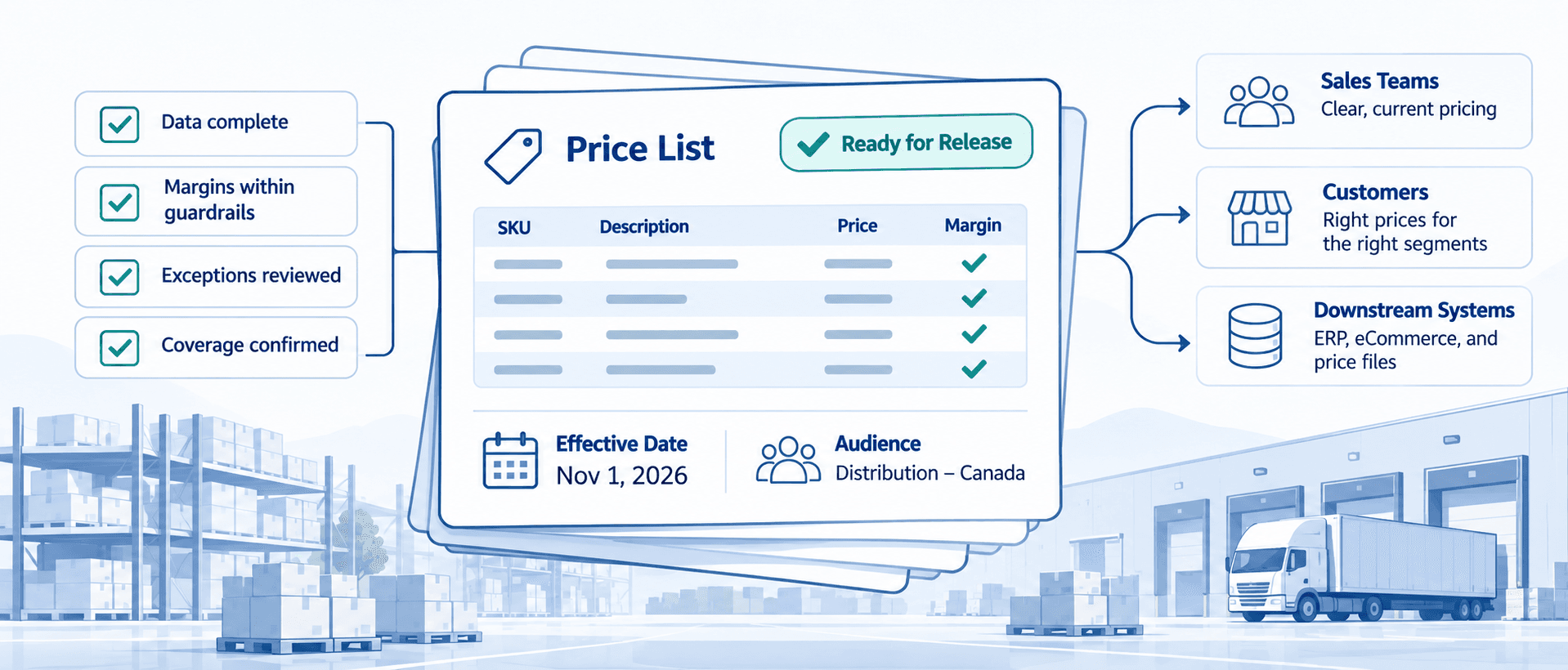
Publishing price lists should be treated as a release process, not just a file export. Teams need controlled scope, accountable review, and clear downstream execution so the right price is applied in the right context.
A list can be mathematically correct and still create commercial risk if it reaches the wrong audience, activates at the wrong time, or includes unresolved exceptions. Release discipline is what turns price output into dependable operational behavior.
Treat Publishing as a Governed Commercial Record
Before release, define list identity, audience, status, and effective period. For multi-segment catalogs, audience and eligibility should be explicit so teams do not rely on tribal knowledge during execution.
Product scope must be explicit too: full catalog, category subset, or targeted item group. Missing cost, discontinued SKUs, and unsupported units should be visible exceptions that require decision, not silent carryover.
Validate Readiness Before Release
Final checks should cover data completeness, margin guardrails, duplicate records, and unchanged items that may signal missed updates. Teams should also compare against the current active list and review unexpectedly large moves by category sensitivity.
Readiness should be practical for users: sales must identify applicable prices quickly, customer service must explain date logic, and finance must reconcile expected margin behavior. If answers depend on interpretation, release is not ready.
Guardrails are most effective when linked to explicit workflows and exception ownership, as described in our margin guardrails guidance.
Define Approval and Effective-Date Rules
Approval depth should match risk: routine changes within policy can be lighter than customer-specific deviations or large category resets. Release owners need decision context, not only output files.
Distinguish publication from activation. Some organizations publish in advance and activate later. Ensure receiving systems honor scheduled timing, transition rules, and time zone constraints.
Where quote workflows consume released pricing, handoff clarity matters to avoid stale or premature pricing use. See related guidance in pricing approval workflows.
Separate Base Lists and Exception Layers
Exceptions are unavoidable, but they need ownership, scope, rationale, and review cadence. Keep base list intent distinct from temporary and account-specific overrides so release governance remains transparent over time.
After activation, monitor rejected imports, quote exceptions, manual overrides, and unusual margin movement in the first days. A controlled response path prevents local workarounds from becoming systemic behavior.
Practical Release Sequence
For large catalogs, reliable release follows a clear sequence: define scope, resolve or explicitly exclude exceptions, review commercial impact, prepare outputs with consistent identifiers, and verify execution in downstream systems.
NewAxiom supports this workflow by connecting analysis, review, and publishing readiness in one shared process so teams can move from pricing decisions to controlled operational execution.