
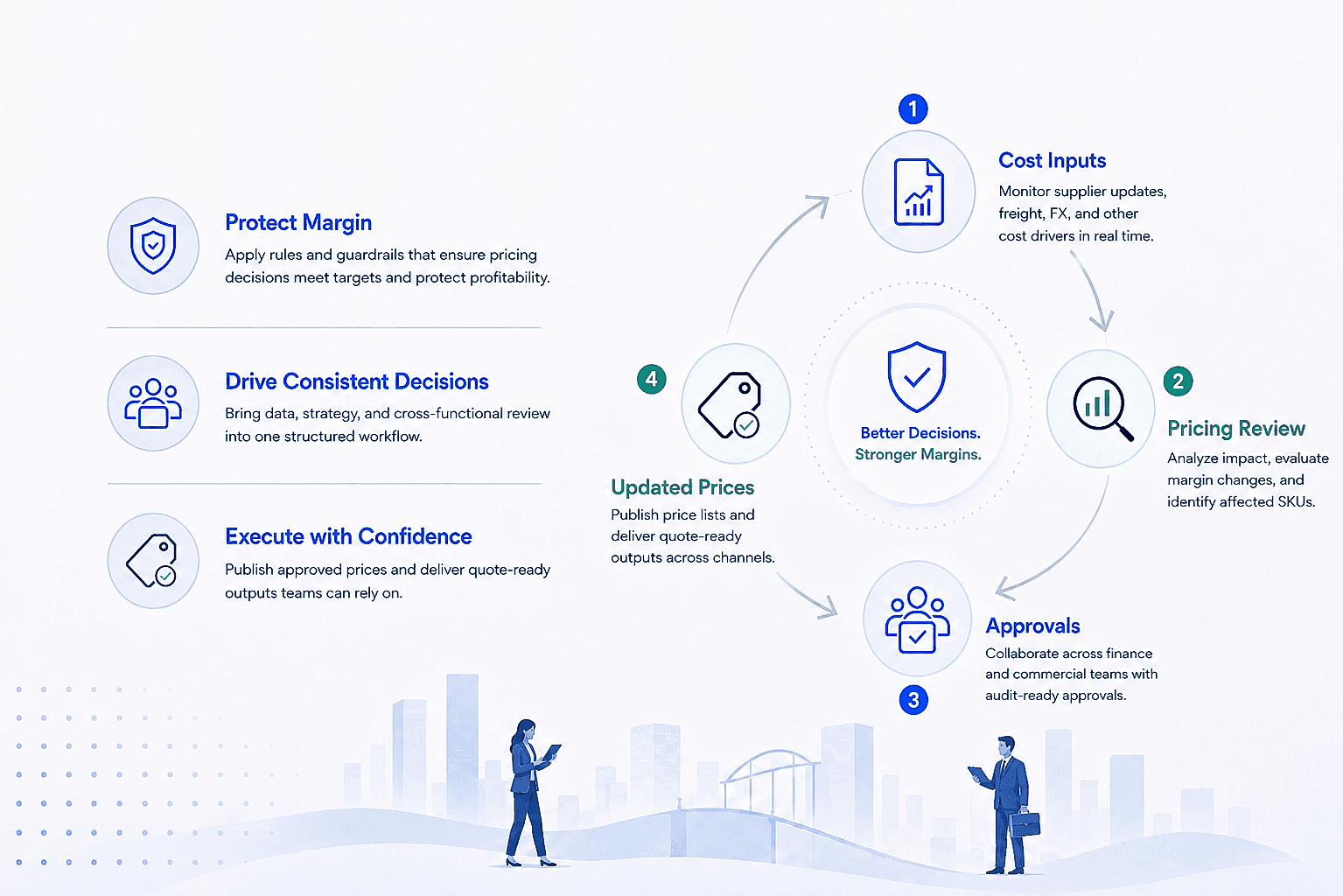
When pricing decisions are spread across disconnected files and informal handoffs, the organization can move quickly without knowing whether it is moving consistently.
Pricing decision management creates the operating discipline behind those choices. It brings the data, rules, review steps, exceptions, approvals, and execution outputs into a controlled process. The objective is not to remove judgment from pricing. It is to ensure that judgment is applied where it matters, documented clearly, and carried through to the price lists and quotes used in the market.
What Pricing Decision Management Actually Manages
Pricing management is often reduced to calculating a recommended price. That is only one part of the job. For a distributor or manufacturer with a large catalog, the harder work is deciding which products require action, what rule should apply, who can approve an exception, and how the approved decision reaches customers and sales teams.
A managed process coordinates several related decisions. It starts with the relationship between product data, current cost, sales history, demand signals, and existing prices. It then applies commercial logic such as target margin, category strategy, competitive position, customer commitments, and minimum-margin guardrails. Finally, it records the decision and produces an executable output.
This distinction matters because an analytically sound recommendation can still fail operationally. A proposed increase may conflict with a customer-specific agreement. A price may meet a margin target but be out of line with a category strategy. A reviewer may approve an exception, but the updated price may not reach the quoting process. Decision management closes those gaps.
The Pricing Decision Management Cycle
The strongest pricing operations use a repeatable cycle rather than treating each change as a one-off event. The cycle does not need to be rigid. It does need clear inputs, accountable review, and a defined endpoint.
1. Establish a reliable decision baseline
Every pricing decision depends on the quality and timing of the underlying data. Product master data, current and historical costs, sales transactions, customer information, price lists, and open quotes need a common structure before meaningful review can begin.
This is where many teams lose time. Data may exist in ERP exports, supplier records, sales reports, and local working files, but each source can use different product identifiers, dates, units of measure, or customer labels. The practical requirement is not perfect data in every system. It is a governed baseline that makes the affected products, current position, and data confidence visible.
A connected platform should preserve the source context while organizing it for action. NewAxiom uses data Connectors and centralized workspaces to bring product, cost, sales, demand, pricing, and quote information into the same operational view. That reduces the manual reconciliation required before a pricing review can start.
2. Identify where review is warranted
Not every item deserves the same level of attention. Applying a uniform markup across an extensive catalog may be fast, but it can ignore low-margin products, strategic lines, contract accounts, and items with limited demand or unusual cost movement.
Effective review begins by segmenting the catalog into decision groups. A team may group products by category, supplier, margin exposure, demand pattern, customer type, or price-list assignment. The right segmentation depends on the business. A high-volume distribution operation may prioritize margin dollars and transaction frequency, while a manufacturer may need more emphasis on product family economics and channel position.
The goal is to focus human review on material commercial risk. Routine changes within established guardrails can move through a lighter path. Decisions that create significant margin loss, exceed a defined price movement, affect key customers, or conflict with strategy should be visible for closer examination.
3. Apply strategy and guardrails before approval
A price recommendation is useful only when the logic behind it is clear. Decision-makers need to see the proposed price, expected margin, prior price, cost movement, sales exposure, and the rule or strategy that produced the recommendation.
A Strategy Builder can turn commercial policy into repeatable operating logic. A category manager may set a margin floor for one product group, use a different approach for price-sensitive lines, and maintain customer-specific treatment for contractual business. The system should make those rules usable at scale while allowing authorized people to override them when the market justifies it.
Guardrails are not meant to prevent exceptions. They make exceptions deliberate. If an account manager requests a lower price to retain a major opportunity, the reviewer should be able to assess the margin impact, volume context, and reason for the request rather than approve a number without context. The exception becomes a visible decision, not an invisible leak.
4. Review decisions in the right workspace
Pricing reviews become unreliable when teams must assemble context from multiple reports before they can decide. A dedicated Pricing Workbench should present affected items, recommended actions, relevant commercial measures, and approval status in one place.
The review process should also distinguish between different types of work. A broad catalog price update requires a different view from a customer-specific quote. Demand changes may require another set of inputs, including forecast assumptions and inventory or supply considerations. Separating these workstreams while connecting their data prevents a single overloaded review queue from obscuring priorities.
For larger decisions, reviewers should be able to work by exception. That means filtering for products below margin thresholds, items with large proposed movements, categories with declining demand, or records missing required data. The value is practical: senior reviewers spend their time on decisions that need commercial judgment rather than checking ordinary items one by one.
5. Approve, publish, and trace the outcome
Approval is a control point, not an administrative formality. It confirms that the right person reviewed the decision, that exceptions were acknowledged, and that the approved result is the version that reaches execution.
Once approved, pricing must flow into governed outputs such as Price Lists, customer quotes, or exports for downstream systems. A process is incomplete if sales teams continue using outdated price information or if a quoted price bypasses the same margin discipline used for catalog updates.
Traceability matters after publication as well. When a margin question arises, the team should be able to identify the prior price, relevant cost, rule applied, reviewer, approval status, and effective output. That record supports finance, sales operations, and pricing leadership without forcing a reconstruction exercise weeks later.
Where Organizations Overcorrect
There are two common mistakes in pricing control. The first is excessive centralization. Requiring senior approval for every minor change creates delays and encourages users to work around the process. The second is excessive automation. Allowing rules to publish large volumes of prices without meaningful exception handling can create fast, poorly understood exposure.
The appropriate balance depends on catalog size, pricing volatility, authority structure, and commercial risk. High-volume, low-risk changes can be governed through predefined thresholds and sampled review. Strategic products, key accounts, unusual market conditions, and decisions below margin floors require more direct scrutiny. Good governance is risk-based, not uniformly bureaucratic.
Measures That Show Whether the Process Is Working
Pricing leaders should measure more than the number of updates completed. Throughput alone can reward speed at the expense of quality. More useful measures include time from a triggered review to approved execution, the share of price decisions completed within policy, margin movement after implementation, exception volume by category or account, and the percentage of quotes requiring rework.
These measures expose different problems. Slow approval times may indicate unclear authority. Frequent exceptions may reveal that category rules no longer reflect market conditions. Rework on quotes can point to disconnected customer pricing or incomplete product data. The purpose is not to create reporting for its own sake. It is to improve the next decision cycle.
The practical test is simple: when a pricing decision is challenged, can the organization show what changed, why it changed, who approved it, and where the approved price is being used? If the answer is yes, pricing has moved beyond calculation and into controlled commercial management.