
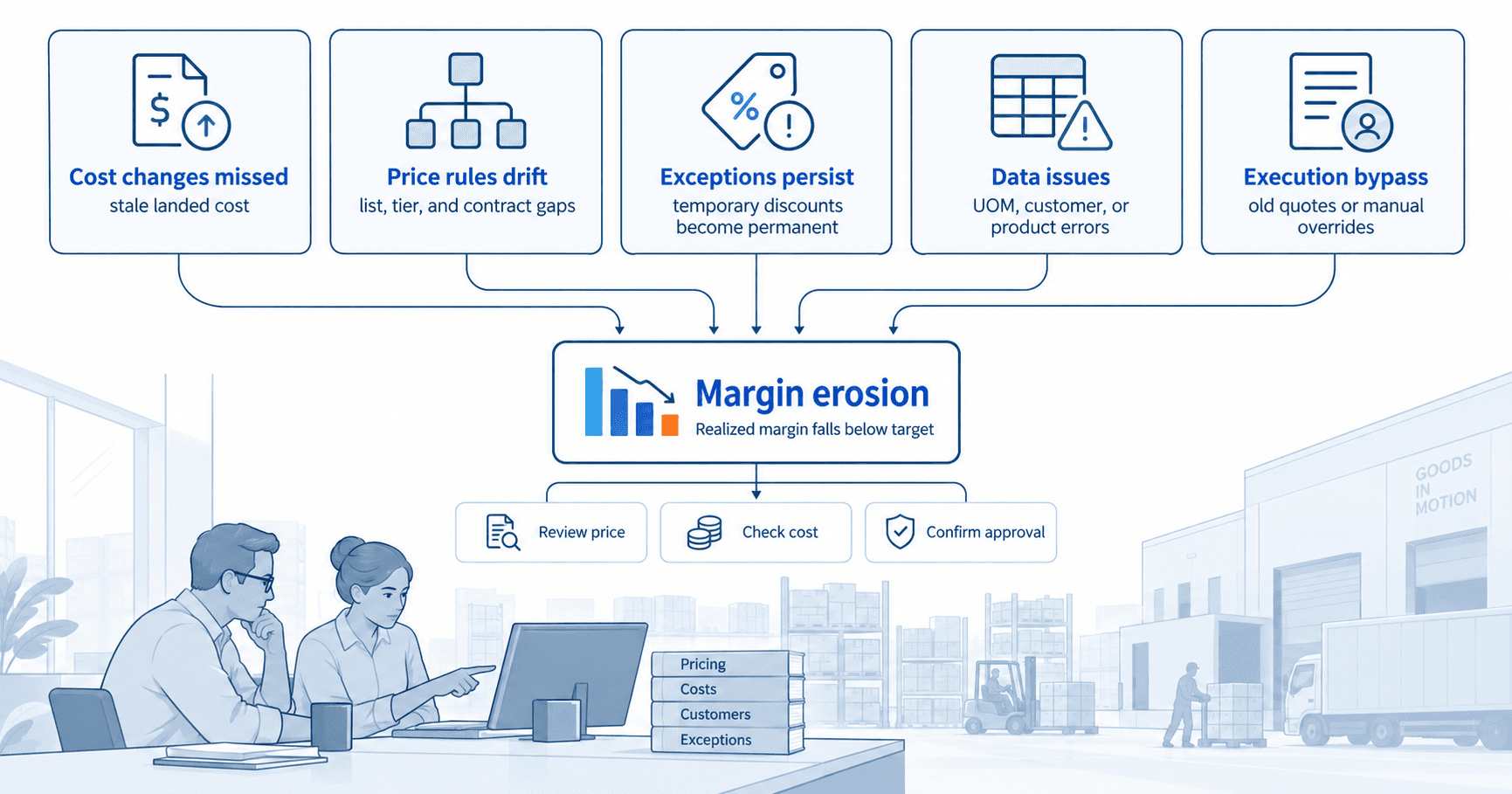
Understanding what causes catalog margin erosion requires looking at the accumulated gap between intended pricing policy and what is actually quoted, sold, and executed.
For distributors and manufacturers with large product ranges, erosion is usually an operational problem before it becomes a financial result. Costs, product attributes, customer agreements, discount authority, and published prices all change at different speeds. When those changes are not connected through a controlled review process, the catalog gradually stops reflecting the economics it was designed to protect.
What Causes Catalog Margin Erosion?
Catalog margin erosion occurs when realized margins fall below the margin expected from a company's cost, price, and discount strategy. It is not limited to a cost increase that was missed. It can result from stale cost inputs, inconsistent pricing rules, uncontrolled customer exceptions, incorrect product data, or poor execution of approved decisions.
The first discipline is to define the margin being protected. A standard gross margin view may compare invoice price with product cost. A more complete commercial view may also account for freight, rebates, currency exposure, handling, commissions, and contract allowances. The right definition depends on the business, but it must be consistent. A team cannot manage catalog margin if finance, sales, and pricing are each reviewing a different version of cost or profitability.
Cost Movement That Does Not Reach the Catalog
The most visible source of erosion is cost change that is not reflected in selling prices. But the problem is broader than a direct vendor increase. Landed cost can shift because of freight, duty, currency, packaging, minimum-order quantities, or a discontinued rebate. A replacement item may also carry a different cost structure even when it appears equivalent to the customer.
The real exposure lies in timing and scope. A change may be loaded for the core items but missed on low-volume SKUs, alternate pack sizes, regional assortments, or customer-specific price lists. Those items can remain underpriced for months because they do not generate enough volume to attract attention individually. Across a long tail of catalog items, small losses can become material.
Cost review also needs effective dates. Applying a future cost too early can damage competitiveness; applying it too late can create avoidable margin loss. The decision is not always to pass through every change immediately. Leaders may elect to hold price on strategic products, absorb a temporary increase, or recover margin elsewhere in a category. The key is that these choices are explicit, measured, and approved rather than accidental.
Price Architecture That Drifts From Strategy
Catalogs often contain more price logic than their owners realize. Base prices, category markups, customer tiers, regional adjustments, contract prices, promotion rules, and quantity breaks may have been established at different times for valid reasons. Over time, the relationship among them can break down.
For example, a category manager may update a base list price while an older customer matrix still applies a discount to an obsolete list. A new SKU may inherit a default markup that is inappropriate for its cost band. A price floor may not account for a lower-margin product family. Each rule can be reasonable in isolation, yet their interaction creates margin leakage.
This is why catalog pricing should be reviewed as an architecture, not as a collection of individual prices. Teams need to see where rules overlap, which products fall outside expected margin bands, and whether the intended hierarchy of list, customer, and transactional prices still holds. A single target margin across the entire catalog is rarely the answer. Margin guardrails should reflect product substitutability, customer value, market position, and cost volatility.
Exceptions That Become Permanent Prices
A strategic exception is not a pricing failure. A major account may require a negotiated price, a project may justify a temporary concession, or a competitive situation may warrant flexibility. Erosion begins when exceptions are created without clear commercial rationale, expiry dates, ownership, or review.
Temporary project pricing can become the price a customer expects on repeat orders. A salesperson may reuse a historic quote because it is easier than rebuilding the commercial case. A customer-specific price may continue after the underlying volume commitment has changed. In each case, the organization has converted a controlled exception into an unexamined rule.
The challenge is not to eliminate discretion. Excessively rigid controls can slow response times and push valid decisions outside the approved process. Instead, distinguish between price flexibility and price ambiguity. Material exceptions should capture the commercial reason, a responsible owner, and, where appropriate, an effective period or review date. The level of review and approval should reflect the potential margin impact. Exceptions that remain commercially valid can be renewed deliberately; those that no longer serve their purpose should be retired.
Product and Customer Data That Changes the Economics
Margin calculations are only as reliable as the data behind them. Unit-of-measure errors are a common example: cost may be stored per case while price is evaluated per each, or conversion factors may be incomplete for a new packaging format. Product substitutions, discontinued items, duplicate records, and missing cost fields create similar problems.
Customer master data matters as well. A customer may be assigned to the wrong pricing group, eligible for an expired agreement, or associated with a parent account whose terms do not apply to a local buyer. These errors can be difficult to spot in transaction-level reporting because the invoice itself may be technically valid.
Data quality work should focus on commercial consequences, not only record completeness. Prioritize records with missing or conflicting costs, unexpected margin outcomes, high sales value, active quotes, and imminent price changes. A complete master file is useful; a master file that identifies the data conditions capable of creating a loss is more useful.
Quote and Order Execution That Bypasses Control
An approved catalog is not the same as an executed price. Margin can erode when quotes use old price versions, discounts are entered manually, order changes do not trigger reapproval, or a sales team cannot easily confirm the current price and cost position before responding to a customer.
This is particularly relevant for products with frequent cost movement or complex customer agreements. A quote that was acceptable last month may no longer meet the required margin today. The commercial response should not be to reject every existing quote automatically. It should be to make effective dates, cost changes, and approval thresholds visible to the people making the decision.
Controlled execution also creates a clearer decision record. When a price is below its normal guardrail, the business should be able to determine whether it reflects an intentional commercial decision, a data issue, or a process failure. Without that distinction, margin analysis becomes a retrospective exercise in reconstructing what happened.
Diagnose Erosion by Following the Decision Path
The fastest way to find the source of erosion is to trace a sample of low-margin sales from result to decision. Start with products or customer segments where realized margin has declined, then compare the transaction price with the reviewed or expected price, the effective cost, and the relevant customer terms. The goal is to identify where the expected logic changed.
If transaction prices are consistently below the reviewed or expected prices, the issue may be execution or discount authority. If the selected pricing is below policy, investigate exceptions, price rules, and the decisions made during review. If the pricing appears sound but margins are still weak, examine cost timing, landed-cost components, and product data. This sequence prevents teams from treating every margin problem as a list-price issue.
Segment the analysis by category, customer type, product velocity, and cause code where possible. A few high-revenue SKUs may require immediate intervention, while a widespread pattern of small exceptions may point to a structural control problem. Both matter, but they require different actions.
Build Controls That Preserve Commercial Judgment
Margin protection works best when the review process matches the scale and volatility of the catalog. High-risk changes need focused attention. Stable, low-impact updates should move quickly through defined rules. The objective is not more approvals for their own sake. It is faster handling of routine work and stronger review where the decision can materially affect profit.
A connected system such as NewAxiom can help teams bring product, cost, sales, demand, and pricing information into the same working environment. Pricing review can then focus on the changes that need judgment: items outside target ranges, customer-specific impacts, cost movements with uncertain pass-through, and exceptions requiring additional review. Reviewed pricing can then move into controlled price lists and quote workflows with clearer visibility into the commercial context.
The useful question is not whether a catalog has a margin problem at the total level. It is whether the organization can explain why any price is where it is, what decision led to it, which cost it reflects, and when it should be reviewed again. When those answers are available before the order is entered, margin protection becomes a practical operating discipline rather than a monthly surprise.