
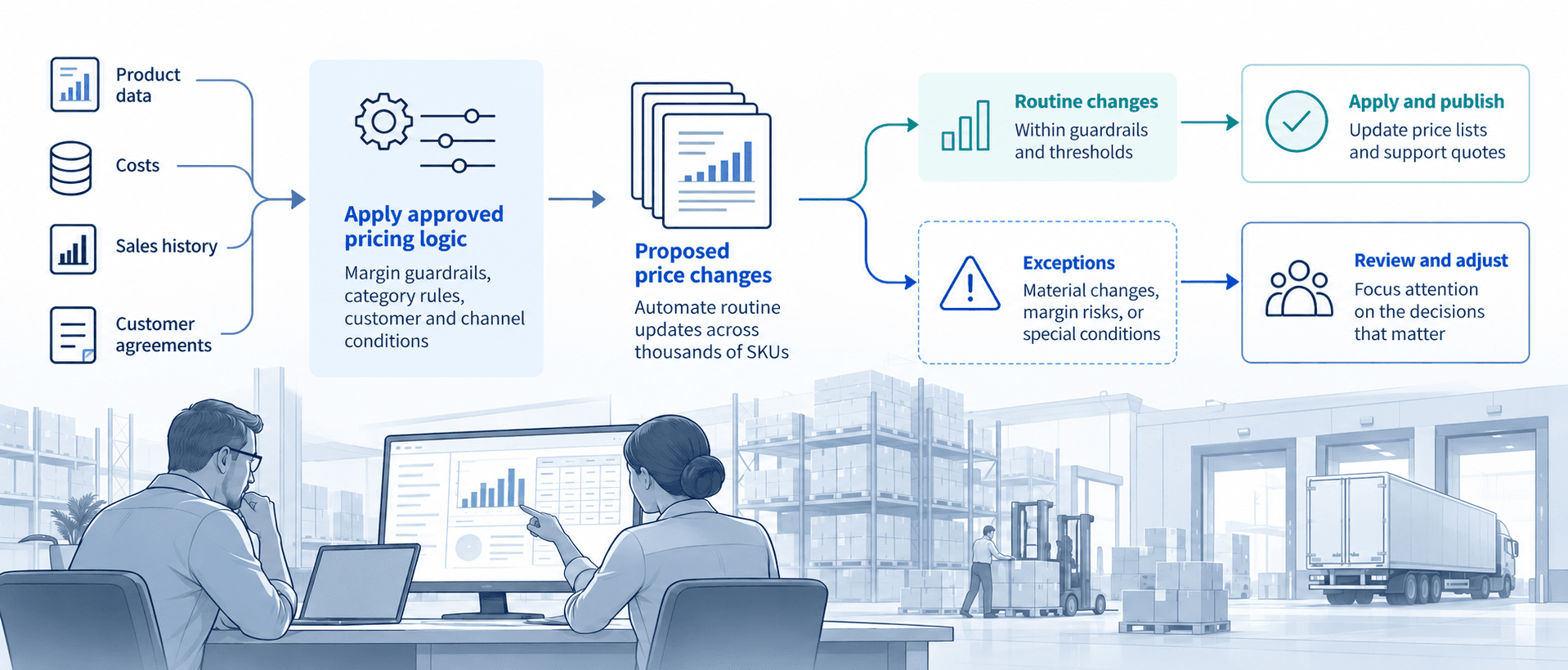
A pricing manager should not have to choose between speed and control. Yet that is often the practical result when thousands of SKUs, customer agreements, category rules, and changing costs must be reconciled manually. Pricing automation changes that trade-off when it is designed to organize decisions, not merely generate prices.
For distributors and manufacturers, the goal is not to change as many prices as possible without human involvement. It is to make routine work repeatable, expose the exceptions that deserve attention, and give commercial teams enough context to make defensible decisions.
What Should Pricing Automation Actually Automate?
The term pricing automation can describe several different activities. An optimization engine may recommend a price. A spreadsheet macro may calculate a markup. An integration may transfer updated prices to another system. Each can be useful, but none, on its own, answers the operational question: Which work can follow established rules, and which decisions still need a person?
The repeatable work is a sensible place to start: importing and validating product and cost data, matching records, calculating proposed prices, applying margin guardrails, comparing proposed and existing prices, and preparing controlled price-list or quote outputs.
Commercial judgment belongs at the points where the standard rule may not fit. A strategic account item, a contract product, or a price-sensitive competitive line may warrant a different response from a low-volume catalog item governed by a stable category rule. Good automation makes those differences easier to see rather than forcing every item through the same treatment.
The Real Problem Is Decision Volume
Catalog-scale pricing creates more decisions than a team can reliably manage through informal coordination. A landed-cost change may affect several product families. Branches may carry different freight assumptions. Customer terms can complicate standard price logic. A price increase that protects unit margin may still deserve scrutiny when sales patterns or competitive conditions are changing.
The risk is not simply a wrong calculation. It is losing the connection between the calculation, its assumptions, the exception, and the price eventually used by sales. Teams should be able to answer: Which items changed? Which rule produced the proposal? Where are margins at risk? Which prices still need review? What output is ready to use?
Pricing automation should reduce the volume of manual investigation, not conceal the remaining decisions behind a black-box recommendation. Its value lies in helping a team spend less time recreating calculations and more time resolving commercially significant exceptions.
An Illustrative Example: 8,000 SKUs, but Not 8,000 Equal Decisions
Imagine a distributor preparing a pricing update for 8,000 SKUs after receiving revised supplier costs. Without a consistent process, reviewers may spend hours sorting files, matching products, recalculating margins, and scanning rows for unusual results.
With rule-based calculations and clear guardrails, the team can prepare proposed prices across the full set and then concentrate on items with missing or uncertain costs, margins below policy, unusually large changes, or important customer considerations. A routine item that remains within expected boundaries does not demand the same investigation as a high-volume product whose proposed price would materially change its market position.
This is an illustrative scenario, not a measured NewAxiom result. The point is not that a fixed percentage of items can safely bypass review. It is that automation can organize a large decision set so people can review it proportionately to risk and commercial importance.
Build the Boundary Between Routine Work and Human Review
A practical approach has three connected responsibilities: prepare reliable inputs, calculate proposals consistently, and make exceptions visible before prices are used. Price lists, quotes, and exports then carry the reviewed results into the next stage of work.
First, trust the inputs. Before automating a pricing calculation, define the cost basis, current sell price, product hierarchy, units of measure, and relevant sales or customer context. An unmatched SKU or stale cost should be visible as a data issue, not silently treated as a valid basis for a new price. More sophisticated pricing logic cannot compensate for unreliable inputs.
Second, establish guardrails. Category-specific margin expectations, price-change thresholds, and other commercial rules provide a repeatable starting point. A proposed price that falls below a margin floor or represents an unusually large change should be easy to identify. Customer agreements and strategic account considerations may also call for review, even when the calculation itself is correct.
Exceptions are not necessarily failures. They may reveal a cost mismatch, a legitimate competitive response, an outdated rule, or a customer commitment that needs special treatment. The purpose of a Pricing Workbench is to make proposed prices and relevant product, cost, sales, and margin context easier to examine and adjust—not to substitute an automatic approval decision for commercial judgment.
Use Demand Context Without Pretending to Predict Every Outcome
Cost-plus pricing provides a useful baseline, but protecting unit margin is not the only consideration. Sales trends, demand signals, product importance, inventory context, and competitive sensitivity can all influence whether a proposed change deserves additional scrutiny.
Demand analysis can help teams recognize where sales activity is changing and where a uniform pricing response may be inappropriate. It does not guarantee that a particular increase will be absorbed by customers or predict price elasticity with certainty. The available evidence should inform the review, alongside account knowledge and market conditions.
For many teams, a disciplined view of historical sales and forecast signals is more useful than an elaborate model built on incomplete data. Automation should bring that context into the decision while leaving room for experienced people to interpret it.
Measure Better Decisions, Not Just Faster Calculations
A pricing automation program should be judged by operational and commercial outcomes—not by the percentage of records processed without human involvement. A high automation rate can be misleading if unresolved exceptions simply reappear during quoting or downstream execution.
Useful measures include the time from validated data intake to a usable price list, the number of items needing rework, the frequency and value of margin exceptions, the accuracy of published outputs, and realized margin after changes take effect. Recurring exceptions can also reveal where cost data, category rules, or commercial policy need attention.
For material decisions, teams should aim to retain enough context to explain the cost basis, rule, proposed change, review outcome, and resulting price. The appropriate level of documentation depends on the organization's operating model; it should not be confused with an assumption that every pricing platform includes formal approval routing or a complete audit-history system.
Choose a Connected Pricing Workflow, Not an Isolated Automation Feature
A point tool can automate one task well, such as calculating markups, generating a quote, or transferring a price file. The gaps appear when teams must reconstruct context at each handoff or manually reconcile competing versions of the same pricing decision.
NewAxiom connects product, cost, sales, and demand information with pricing review, strategy, price lists, and quoting workflows. Teams can apply pricing logic, examine proposed changes in the Pricing Workbench, and use reviewed results to prepare downstream outputs. The emphasis is on connected information and controlled pricing work, not a claim that every exception is automatically routed or approved.
The best starting point is one recurring pricing activity with defined products, reliable inputs, and clear guardrails. Make routine calculations repeatable, make exceptions visible, and evaluate whether the resulting prices are easier to explain and use.
The measure of effective pricing automation is not how many prices change without human involvement. It is how consistently routine work is handled, how quickly exceptions become visible, and how confidently teams can act on the decisions that matter.