
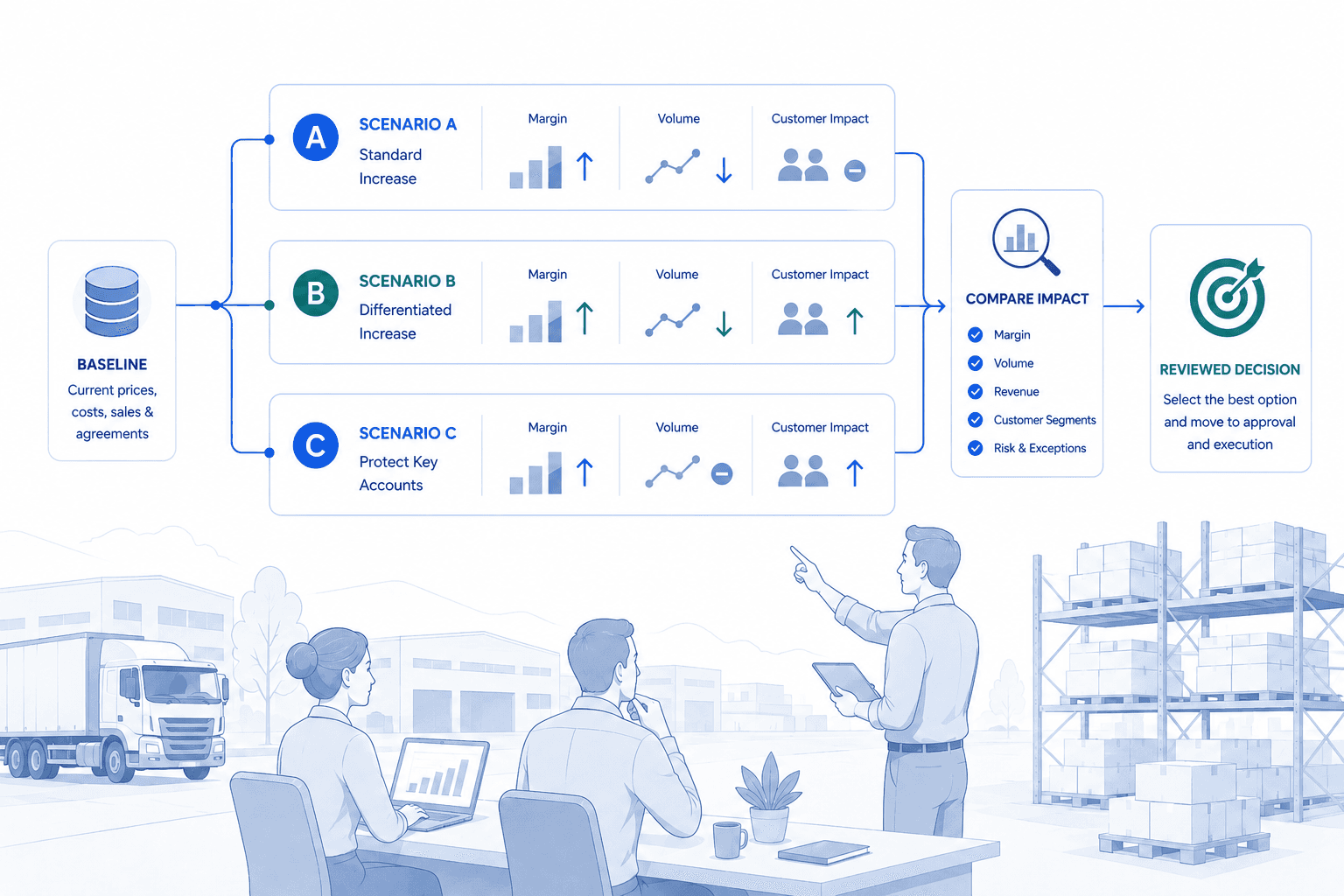
That is the purpose of pricing scenario planning for distributors: to test the commercial consequences of a decision before that decision becomes a price list, quote, or customer conversation.
For distributors managing thousands of SKUs and varied customer agreements, scenario planning is not a forecasting exercise performed once a year. It is a controlled way to answer practical questions. Which items need action? How much margin is at risk? Which accounts should be treated differently? What happens if sales volume changes after the new price takes effect? And which exceptions deserve approval rather than automatic execution?
Why Pricing Scenarios Matter at Catalog Scale
A single proposed rule can affect results very differently across the catalog. A 4% increase may protect margin on standard products with stable demand, yet leave low-margin items exposed where landed cost has risen more sharply. It may also create a customer-specific issue where a negotiated price is already close to the new floor.
Without a defined scenario process, teams often review changes as isolated rows. The review may identify obvious exceptions, but it does not always show the combined effect on revenue, gross margin, price realization, or affected customer segments. That gap leads to broad adjustments that appear efficient but introduce avoidable risk.
Scenario planning creates a decision record before execution. It brings together the inputs required to make a commercial judgment: current and proposed cost, historical sales, current prices, demand assumptions, category strategy, customer agreements, and approval guardrails. The goal is not to remove judgment. It is to make judgment consistent, visible, and easier to defend.
Start With the Decision, Not the Data Set
The most useful pricing scenarios begin with a specific decision that must be made. "Review prices" is too broad. A stronger starting point is: determine the required action for a product category, assess whether a customer segment can absorb a change, or evaluate alternatives to restoring a target margin.
The question determines the scenario scope. A category manager may need to compare a uniform percentage increase against differentiated changes by product family. A pricing manager may need to isolate items that fall below a margin threshold. Finance may want to see the revenue and gross-margin effect of holding prices on strategic accounts while applying a new rule to the remainder of the book.
Clear scope also prevents a common failure: mixing unrelated decisions in one review. When contract items, standard list items, slow-moving inventory, and high-volume lines are all evaluated by the same rule, the resulting output is difficult to approve and even harder to explain.
Establish a reliable baseline
Every scenario needs a baseline that represents the current commercial position. At minimum, this includes the active sell price, relevant cost, sales quantity, revenue, gross margin, and customer or product attributes needed for segmentation.
The quality of that baseline matters more than the sophistication of the calculation. If the current price list is incomplete, costs are misaligned to products, or sales history is not associated with the right customer group, the scenario will create false confidence. Teams should identify missing records, stale costs, and unusual transactions before treating scenario results as decision-ready.
A connected pricing environment helps keep the baseline consistent. NewAxiom brings product, cost, sales, demand, pricing, and quote information into one governed process so teams can review changes using the same underlying business context.
Build Scenarios Around Realistic Choices
A useful scenario compares options that the business could actually execute. It should not simply calculate the maximum theoretical price increase. Distribution leaders need choices that account for market position, customer commitments, inventory exposure, and competitive sensitivity.
For a category under margin pressure, a team might compare three approaches: apply a standard adjustment to all eligible products, use differentiated adjustments based on cost movement and current margin, or protect selected strategic accounts while recovering margin elsewhere. Each option has a different effect on revenue, gross profit, customer exposure, and workload for sales teams.
Demand assumptions should be explicit. A scenario that assumes no volume response may be appropriate for low-elasticity, highly specified products. It is less credible for competitive, frequently substituted items. Rather than claiming precision where none exists, teams can model a reasonable range: stable volume, modest volume reduction, and a more conservative case for sensitive segments.
That range changes the discussion. Instead of debating whether a proposed increase is "too high," reviewers can see the conditions under which it protects margin and the conditions under which it could reduce contribution.
Use Rules to Find Exceptions, Then Review the Exceptions
Rules are essential at catalog scale, but they should guide human attention rather than replace commercial accountability. A pricing rule might set a target margin, a minimum gross-profit dollar threshold, or a maximum movement for a customer class. It can identify products that require action and those that fall outside acceptable guardrails.
The review should focus on what the rule cannot know on its own. A low-margin item may be part of a bundled customer arrangement. A price increase may be commercially sound but timed poorly because an open quote is under negotiation. A product with declining volume may need a different treatment than a high-volume line with the same margin percentage.
A dedicated pricing workbench gives reviewers a focused place to filter affected items, compare current and proposed outcomes, and inspect the commercial drivers behind exceptions before deciding what should move forward. That makes scenario review more practical than relying on a static report alone.
Measure the Outcomes That Support Approval
Margin percentage is necessary, but it is rarely sufficient. An approval decision should show what the scenario changes across the commercial portfolio. Relevant measures often include revenue movement, gross-profit dollars, gross margin, number of affected products, number of affected customers, exposure by branch or sales channel, and the share of items requiring exception handling.
The right measures depend on the decision. When evaluating a broad price list update, coverage and execution readiness may matter as much as the modeled margin result. When reviewing a customer-specific proposal, the focus may be contribution, volume history, competitive context, and consistency with account strategy.
Scenario outputs should also separate modeled results from confirmed decisions. A proposed adjustment is not an approved adjustment. Keeping those states distinct reduces the risk that draft logic is accidentally exported or communicated before review is complete.
Turn an Approved Scenario Into Controlled Execution
Scenario planning only creates value when the approved outcome can be carried into the operational systems and teams that use it. The handoff should be structured: reviewed pricing decisions can inform governed price lists, quote preparation, and downstream exports, with clear effective dates and ownership.
Execution needs controls of its own. Teams should confirm that approved changes reach the intended price lists or downstream outputs, that expired prices are handled appropriately, and that known exceptions are preserved through the handoff. Sales and quoting teams need enough visibility to understand the approved pricing direction without relying on informal interpretations of the scenario.
After implementation, compare actual results with the scenario assumptions. Did the expected margin improvement appear? Did volume shift in the segments identified as sensitive? Were there more manual overrides than expected? This feedback improves future scenarios and reveals where a pricing rule, demand assumption, or data definition needs adjustment.
Make Pricing Scenario Planning for Distributors Repeatable
The strongest process does not depend on one analyst remembering which files to combine or which exceptions were discussed last time. It uses a repeatable sequence: establish the baseline, define decision scope, model executable options, review exceptions, approve the chosen action, publish it, and monitor the result.
Repeatability does not mean every decision receives the same treatment. A strategic account renewal deserves more detailed review than a routine list-price adjustment. The benefit of a governed process is that it makes the level of review proportional to the commercial risk while preserving a clear record of why each decision was made.
The next pricing decision will always include uncertainty. The practical advantage is not predicting every market response perfectly. It is giving the right people a controlled way to test choices, recognize trade-offs, and act before margin exposure becomes a result that can only be explained after the fact.